Summary
What an under-£500 budget actually buys in plug-in solar right now, how entry-level starter kits compare on capacity and mounting, and the checks that matter more than price.
What you will learn
- What an under-£500 budget realistically covers in the plug-in solar category
- How entry-level starter kits compare on panel capacity, output and mounting
- Why the cheapest kit is not always the cheapest per kilowatt-hour
- The status and registration checks that apply at every price point
What under £500 buys you
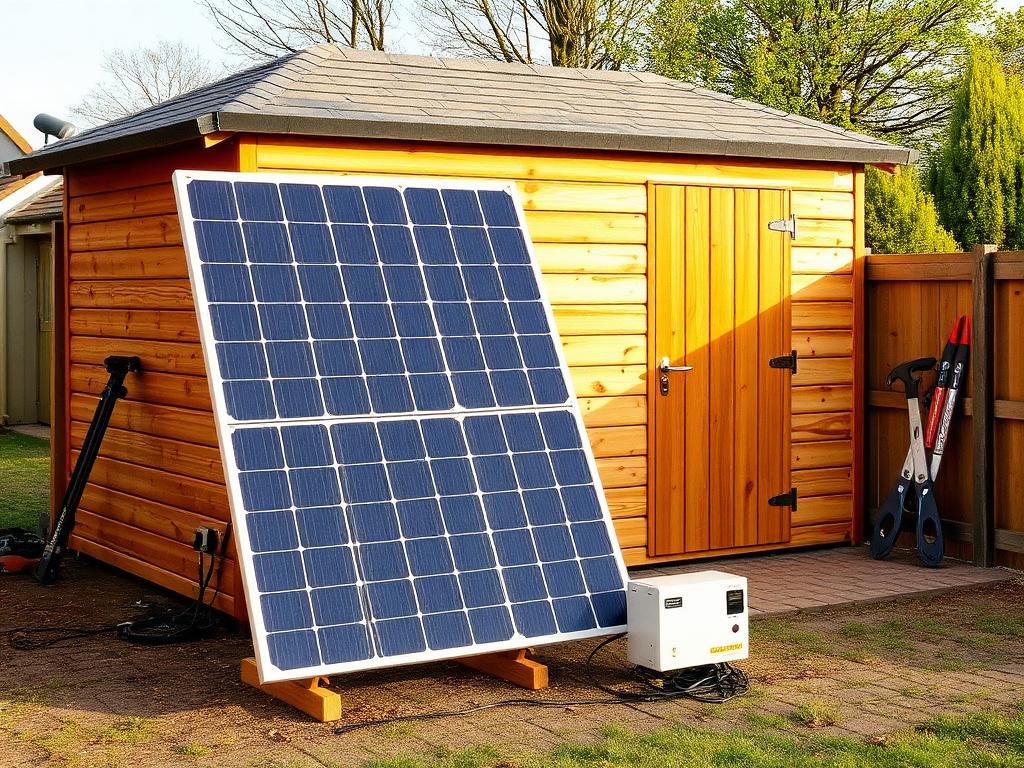
In the plug-in solar category, an under-£500 budget generally points at single-panel starter kits: one panel, a microinverter and the supplied connection assembly, ready to place in a garden, on a patio or against a balcony or terrace. Based on the indicative price bands in our comparison tool, entry-level single-panel kits sit at the lower end of the category, while most two-panel kits start noticeably higher.
Prices in this category move frequently, and every figure on HomeSolarKit.uk is an indicative example band rather than a live quote. Always confirm the current price with the retailer before ordering — use our Under £500 filter to see which kits fall in this range today.
Comparing the starter kits
A single-panel starter kit such as the Perlight PowerPlug MAX 465 carries 465 W of panel capacity (example figure) and is designed for smaller outdoor spaces where a two-panel setup would not fit safely. Its indicative price band starts in the £400s, which is why it is the kit that most closely matches an under-£500 budget in our current listings.
If you can stretch past that, the two-panel kits change the value picture. The City Plumbing 2 × DM465G12RT-G48HBB kit with the Hoymiles HF-800-WB microinverter offers 930 W of panel capacity (example figure) with branch collection options, and the UKSOL Pro Duo ground-mount kit offers 890 W with a purpose-made frame — both from indicative bands in the £700s and up. Panel capacity roughly doubles, but the price more than doubles, because frames, inverters and cabling scale with the kit.
That is the trade worth understanding at this budget: an under-£500 starter kit costs less per kit, but the larger kits usually cost less per watt of panel capacity. The right answer depends on your space and your daytime electricity use, not on price alone.
Price is only half the check
Whatever the price point, the same checks apply. Confirm the exact model code and the product's register status rather than relying on a listing screenshot. Read the installation manual before ordering, including the supplied connection method. Confirm who needs to give permission for your property — especially if you rent or the kit mounts to a shared structure.
And the step that follows every connection — registration with the relevant network operator — applies to an entry-level kit exactly as it does to a larger one. Our registration checklist walks through what to have ready.
Getting the most from a small kit
A single panel generates a modest amount of electricity, so the saving depends almost entirely on using that electricity as it is generated. Households with steady daytime loads — someone working from home, a fridge-freezer and a washing machine cycling through the day — get the most from an entry-level kit. Empty households that use most of their electricity in the evening will see a smaller effect, at any price point.
Run your own numbers in our savings calculator. It shows every assumption it uses, and it values exported electricity at £0 unless your supplier has confirmed an arrangement for your specific system.
Safety and accuracy
Want a number for your own home?
Our calculator shows every assumption it uses, and values exported electricity at £0 unless you tell it otherwise.
Open the savings calculatorRelated kits
 Complete-kit comparison
Perlight PowerPlug MAX 465
Model code: PLM-PPM-M-465
- Listed AC output
- 0.8 kW
- Panel capacity
- 465 W DC
- Mount
- Confirm with supplier
- Recommended space
- Small outdoor spaces
Register reference: PERLI/21158/V1
Verify live register status· checked 2026-08-24Request availability
 Complete-kit comparison
City Plumbing Supplies 2 × DM465G12RT-G48HBB + Hoymiles HF-800-WB Plug-In Solar Kit
Model code: DME-465W-2 V1.0
- Listed AC output
- 0.8 kW
- Panel capacity
- 930 W DC
- Mount
- Confirm with supplier
- Recommended space
- Garden
Register reference: CITYP/21096/V1/A4
Verify live register status· checked 2026-08-24Check latest price